Autonomic Health 101: The Body’s Operating System

For most of human history, medicine revolved around a single idea: balance.
Ancient Greek physicians spoke of balance among the four humors. Ayurvedic medicine described health through harmony between doshas. Traditional Chinese medicine focused on the smooth flow of yin and yang. Different cultures, same intuition. When the body is in balance, we thrive. When it is not, disease follows.
Modern medicine eventually gave this idea a scientific name: homeostasis.
Homeostasis refers to the body’s ability to continuously regulate itself. Heart rate, blood pressure, temperature, digestion, immune activity, hormones, inflammation, recovery from stress. All of these processes are constantly adjusted to keep us alive and functional in a changing environment.
Physiological research has long shown that this balance is not passive. It is actively maintained by neural control systems that continuously adapt the body to internal and external demands.
But for decades, there was a missing link. We understood the principle of balance, but we could not directly observe or measure the system responsible for maintaining it.
That system is the autonomic nervous system.
What is the autonomic nervous system?
The autonomic nervous system, often abbreviated as ANS, is the body’s operating system.
It controls the automatic functions you do not consciously think about but cannot live without. These include heart rate, breathing, blood pressure, digestion, temperature regulation, immune signaling, and the ability to recover after physical or emotional stress. Clinical and physiological reviews describe the ANS as a dynamic, multilevel network that constantly adjusts bodily function to preserve internal stability across changing conditions.
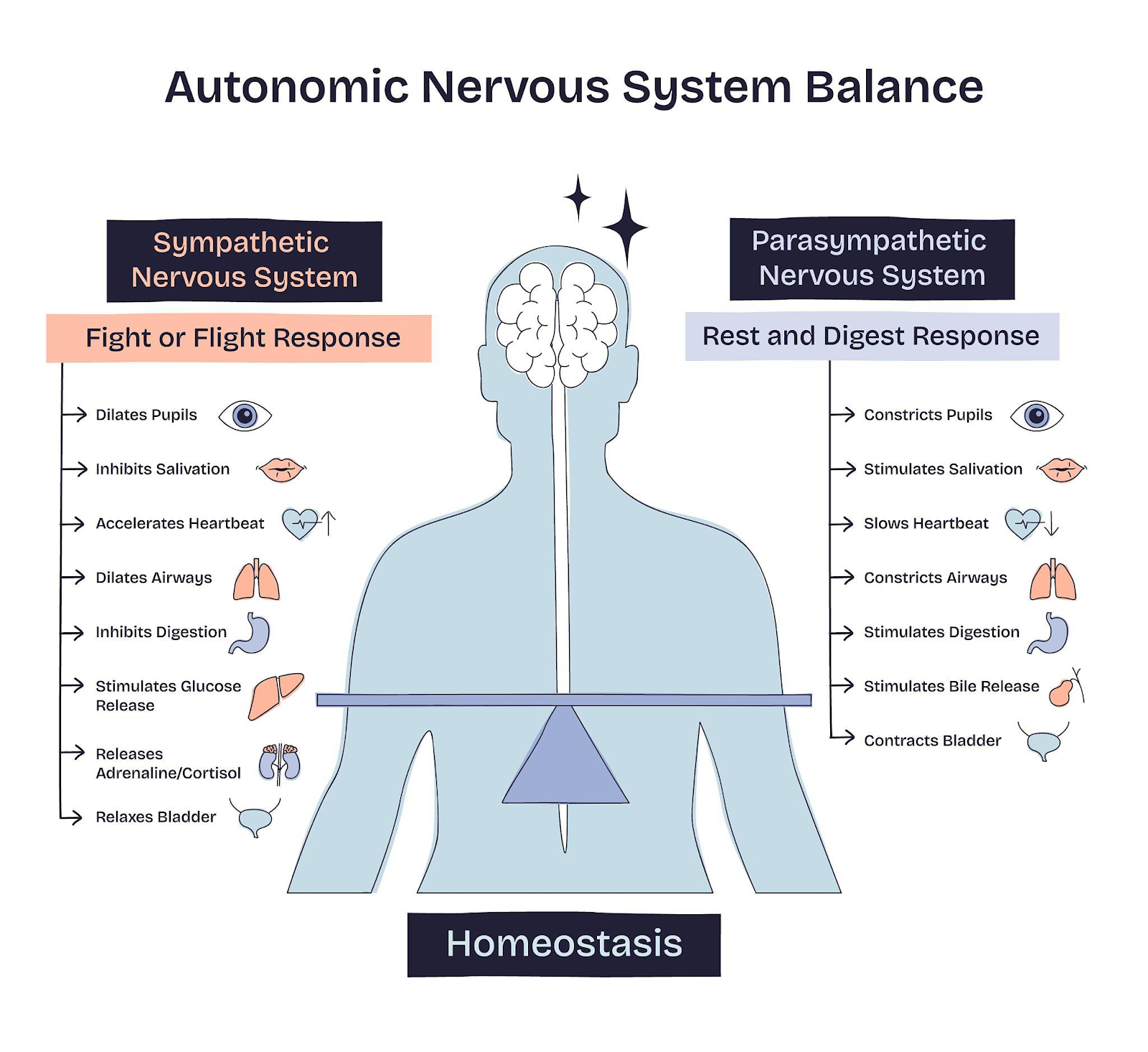
The ANS has two main branches.
The sympathetic nervous system mobilizes the body. It increases heart rate, raises blood pressure, releases energy, and prepares you to respond to challenge. This is sometimes referred to as “fight or flight,” but its role is much broader. You rely on sympathetic activation to wake up, exercise, focus, and perform.
The parasympathetic nervous system restores the body. It slows the heart rate, supports digestion, promotes immune repair, regulates hormones, and allows recovery after stress. This system plays a central role in healing, sleep, and long-term resilience, in part through vagal pathways that help regulate inflammation and immune activity.
Health depends on the dynamic balance and flexibility between these two branches. Not constant calm. Not constant activation. The ability to shift appropriately and efficiently.
When this system is flexible, the body adapts. When it becomes rigid, suppressed, or chronically imbalanced, symptoms begin to appear.
Why imbalance causes symptoms across the body
One of the most confusing aspects of chronic illness is how symptoms can appear everywhere at once.
Fatigue, brain fog, dizziness, digestive issues, heart palpitations, anxiety-like sensations, poor sleep, temperature intolerance. Often with normal blood tests, normal imaging, and no clear diagnosis.
This happens because the autonomic nervous system connects the brain to every major organ system. When regulation breaks down, dysfunction does not stay confined to one place.
Rather than a single broken part, the issue is a regulatory problem.
Clinical reviews and consensus statements have repeatedly noted that autonomic dysfunction is a multi-system condition, affecting cardiovascular, gastrointestinal, metabolic, immune, and neurological function simultaneously, yet it remains under-recognized in routine care.
For decades, medicine focused primarily on structure. Organs, tissues, chemistry. But regulation, how systems behave over time, was much harder to measure. As a result, autonomic dysfunction remained under-identified, even though it plays a central role in conditions such as long COVID, autoimmune disease, metabolic dysfunction, cardiovascular disease, chronic fatigue, and many stress-related disorders.
The missing piece: measurement
Until recently, the autonomic nervous system was largely invisible to clinical care.
Doctors could observe symptoms and track outcomes, but they could not directly measure how the sympathetic and parasympathetic systems were functioning in real time. Even modern tools like blood panels, imaging, and most consumer wearables do not directly assess autonomic regulation.
This is why so many people are told that “everything looks normal” while continuing to feel unwell.
That gap is now closing.
Advances in physiology, signal processing, and measurement techniques now allow objective assessment of autonomic function by analyzing cardiovascular and respiratory signals together, rather than relying on indirect estimates. This makes it possible to observe how the nervous system responds to stress, recovery, and regulatory challenges, rather than guessing based on symptoms alone.
This shift moves healthcare from reaction toward prevention.
Balance is no longer a metaphor
At Autonomic Health, our work is built around a simple idea: balance should be measurable.
Modern autonomic diagnostics allow us to quantify what ancient healers could only sense and what modern medicine could only describe. We can map sympathetic and parasympathetic activity, track changes over time, and identify imbalance long before it becomes a diagnosable disease.
This creates something medicine has never had before: a clinical dashboard for balance.
With objective autonomic data, it becomes possible to personalize care, monitor recovery, and understand why the body is struggling even when traditional tests are normal.
Why autonomic health matters now
We are living through a transition in healthcare.
Just as metabolic health reframed obesity and gut health reframed digestion and immunity, autonomic health is reframing how we understand stress, fatigue, chronic illness, and recovery.
The difference this time is timing. The tools now exist to measure what was previously invisible. Wearables, AI, and validated autonomic testing protocols are converging to make nervous system health accessible at scale.
When balance can be measured, it can be protected.
The future of preventive care
Preventive medicine has long promised to catch disease early, but without insight into regulation, it was incomplete.
The autonomic nervous system sits upstream of many chronic conditions. By understanding and monitoring it, we gain the ability to intervene earlier, personalize care more effectively, and move beyond treating symptoms alone.
Balance is no longer just a philosophy. It is a physiological signal. And it may be the foundation of the next era of healthcare.
Autonomic testing is coming soon
At-home autonomic testing is currently in development.
You can sign up on our website to be notified when testing becomes available and be among the first to understand how your nervous system is functioning.
Your body is constantly sending signals. Soon, you will be able to read them.
Selected references (for readers who want to go deeper)
Goldberger et al., Journal of the American College of Cardiology (2019)
Vinik et al., Diabetic Medicine (2011)
Freeman, Clinical Neurophysiology (2006)
Vinik et al., Journal of Diabetes Investigation (2013)